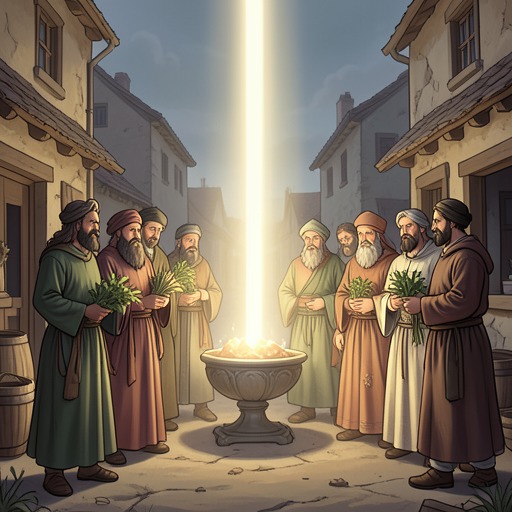
Sacramental use of psychedelics
How to Change Your MindSacramental use of psychedelics is not a single, timeless religious practice but a contested way of using and interpreting psychoactive substances. The book sets the sacrament of Indigenous mushroom practice against the Christian Eucharist, follows the suppression and survival of mushroom ceremonies, and examines how later observers sometimes turned local healing and divination into a universal story about finding God. In contemporary settings, ceremonial and clinical structures alike seek to give powerful experiences a form, even as they differ over what those experiences mean.
Mushroom Sacraments and Competing Religious Authority
The historical account begins with reports of psychoactive mushrooms used in Aztec religious observances. A sixteenth-century description attributed to the missionary Bernardino de Sahagún recounts people eating mushrooms with honey before dawn, then responding in varied ways: dancing, singing, weeping, sitting pensively, or experiencing visions. When the effects had passed, they spoke with one another about what they had seen. The account presents the mushrooms not simply as intoxicants but as substances embedded in collective religious practice, whose visions could include death, danger, captivity, or other consequential scenes.
Spanish colonial authorities treated these ceremonies as a threat to Christian authority. Missionaries condemned the mushrooms in explicitly religious terms, while Indigenous people were interrogated and tortured for information about their use. Sacred mushroom stones, including foot-tall basalt sculptures, were smashed. The Roman Catholic Church brought charges against Native Americans for practices involving peyote and psilocybin; in 1620 it declared plant use for divination contrary to the Catholic faith. This suppression was not only a rejection of an unfamiliar substance. It was a struggle over who could mediate access to the sacred and which substances, rites, and authorities could claim that role.
The Nahuatl name for the mushrooms, Flesh of the gods, made that contest especially legible to Christian observers: it evoked the Eucharist, also understood as divine flesh. The book contrasts the institutional mediation of Christian communion, which depends on faith, priest, and liturgy, with the mushroom sacrament’s apparent promise of direct access to a divine realm. A Mazatec person described the mushrooms as carrying the participant to where God is. The comparison helps explain the intensity of colonial hostility, but it also risks making distinct religious practices seem like rival versions of one doctrine. The point is not that the two traditions were equivalent, but that each attached spiritual authority to a different sacramental form.
Survival, Healing, and the Wasson Interpretation
The practice survived in secrecy for centuries after the conquest. When R. Gordon Wasson turned his search from Asia toward the Americas, he followed scattered reports of mushroom use in remote southern Mexican villages. Beginning in 1953, he made ten trips to Mexico and Central America, several to Huautla de Jiménez in Oaxaca. Initial encounters were guarded: people denied knowledge of the mushrooms, said they were no longer used, or referred him elsewhere. That reticence had a history; the practice had been driven underground under colonial pressure.
Wasson’s 1955 encounter with María Sabina became, for him, evidence for a large theory about the origins of religion. He believed psychoactive mushrooms might have revealed worlds beyond ordinary human experience and helped give early people the idea of God. But the book stresses that he arrived with this hypothesis already in mind. To gain access to a ceremony, he told María Sabina that he was worried about his son and wanted to know where he was and whether he was well. After returning to New York, Wasson considered the information he had received accurate. That outcome reinforced his interpretation, but it did not establish that the ceremony’s purpose was worship.
By 1955, many Mazatecs were devout Catholics, and mushrooms were being used for healing and divination, including efforts to locate missing people or important objects. María Sabina later emphasized that people had taken the mushrooms to help the sick get well, not simply to find God. Wasson knew this practical context, yet presented María Sabina as a religious figure and the ceremony as a form of communion, thereby fitting a complex Indigenous practice to his own theory. The distinction matters: a substance can have sacramental significance without every ceremony being a general act of worship, and an outsider’s account can make the observer’s theology more visible than the practitioners’ purposes.
Modern Ceremonial Forms and Guidance
The book also shows how sacramental understandings persist in contemporary psychedelic culture, where spiritual practice may be eclectic rather than formally tied to one religion. One guide’s office contained a small shrine with objects drawn from different traditions, including a Buddha, a crystal, a crow’s wing, a bowl for incense, sage, and photographs of a Hindu guru and María Sabina. Other guides maintained similar shrines, and clients might bring an item of personal significance. The author came to understand these arrangements not merely as a collection of unrelated religious symbols but as an expression of a community that seeks a shared mystical reality across traditions.
A draft charter for a network of guides described its purpose as making profound experiences more available, including experiences called unitive or nondual consciousness. It listed meditation, breathwork, and fasting alongside the judicious use of psychoactive substances as possible means. The accompanying ethical code recognized that participants may be particularly open to suggestion and exploitation. It placed responsibility for clients’ well-being on the guide, requiring disclosure of risks, consent, confidentiality, attention to safety, restraint from self-promotion, and accommodation regardless of ability to pay. Guidelines for voyagers and guides addressed preparation, intention, drug interactions, difficult experiences, and post-session integration. Together, these documents frame ceremony not as decoration around a drug experience but as a social structure meant to contain risk and support what follows.
The author’s ayahuasca gathering gives that structure a concrete form. The session took place in a yoga studio, not a jungle, with a dozen strangers and a guide in her eighties who had trained under Leo Zeff. She had in turn trained Mary, who guided the author’s psilocybin journey. Singing, prayers, invocations to the plant teacher, bells, rattles, shakapas, and the use of scents and smoke created a shamanic ceremonial setting. The episode shows how contemporary practice can combine inherited guidance with ritual forms far from their original geography. It also preserves a distinction between the ceremony’s effects and the participant’s unresolved interpretation of them: the author describes the gathering and its mood, but does not claim that those features prove a particular theology.
Medicine, Spirituality, and the Work of Containment
Sacramental use also sits alongside, rather than simply outside, medical treatment. In the New York psilocybin cancer trial, Patrick Mettes was assigned to Tony Bossis after preparatory sessions. The plan included two dosing days: an active placebo consisting of a high dose of niacin, which causes tingling, and a capsule containing twenty-five milligrams of psilocybin. Patrick would spend most of each day lying on a couch with eyeshades and music, accompanied by two sitters who remained present and available. Bossis shared Bill Richards’s flight instructions and encouraged Patrick to meet threatening material rather than flee from it. These details locate the experience within a therapeutic protocol, but also show how preparation, music, guidance, and a participant’s orientation help shape its form. The book does not collapse clinical treatment into a religious sacrament; it shows that both can organize an experience that exceeds ordinary expectation.
The tension between medical and spiritual aims had already appeared in Al Hubbard’s 1955 Commission for the Study of Creative Imagination. Hubbard recruited researchers and other figures, named himself scientific director, and sought to take psychedelic work beyond medicine’s focus on illness. The commission’s practical scope is uncertain, but its existence signaled a widening divide. Sidney Cohen resigned in 1957, while Hubbard expressed diminishing regard for science as an end in itself and pursued something he believed lay beyond empirical manipulation. The shift from psychotherapy toward cultural change therefore preceded Timothy Leary. Sacramental use belongs to this wider history of arguments about whether psychedelics are best understood as medicines, spiritual catalysts, or instruments of cultural transformation.
The book’s account ultimately treats sacrament as both a claim about access and a question about authority. The mushroom ceremony could be described as direct contact with the divine, yet its contemporary Mazatec purposes included healing and divination; later guides could invoke mystical unity while relying on ethical codes and practical protocols; clinicians could structure a psilocybin session without declaring it worship. Attending to these differences prevents the word sacrament from flattening distinct practices into one universal experience. It also clarifies why the setting, the guide, the participant’s purpose, and the account told afterward matter: the substance alone does not determine whether an experience becomes communion, treatment, divination, or a story of spiritual discovery.